
Making your home sustainable without savings? This is what the calculation looks like.
.png)
Every. home. sustainable. How do we get there? A hybrid heat pump can be a smart choice for many households. This is shown by research from TNO and CPB. Yet many people are not taking that step yet, especially if they have little savings. The question, therefore, is not whether making homes more sustainable pays off. The question is: how do we make it accessible and clear?
This is why a mortgage sometimes makes sustainability more difficult
In the report Income Effects of the Energy Transition, TNO calculated the financial implications of a hybrid heat pump. On average, such an installation costs €4.710 after subsidies. This is offset by energy savings of approximately €560 per year.
The study assumes that households finance this amount through their mortgage. On paper, that sounds logical. In practice, however, it is often a difficult route for such a sum.
An advisor. A valuation. Closing costs. For an investment of a few thousand euros, these costs can quickly add up. For households with limited savings, the step quickly becomes too big. Or it simply doesn't feel sensible. After all, savings also serve as a buffer for unexpected costs.
And so, many households drop out. Not because they do not want to make their homes more sustainable, but because the financing feels complicated.
A simpler route: the National Heat Fund
Fortunately, there’s a much easier way. For example, through the National Heat Fund. This fund was established by the government to make sustainability initiatives more accessible to homeowners. There are no setup fees, and the terms and conditions are specifically designed to facilitate sustainability.
Let’s take the example of the hybrid heat pump again. But instead of a mortgage, we’ll use the subsidies from the National Heat Fund. This results in the following calculation:
Energy Savings
A hybrid heat pump saves an average of about €47 per month on energy costs.
The loan through the National Heat Fund
For an investment of €4.710, the monthly payment over a 15-year term at 4,23% interest comes to €35,38 gross. Due to interest deductions, that averages out to about €32,41 net per month. For households with a combined income below €60.000, the interest rate is even 0%. In that case, the monthly payment comes to approximately €26 per month.
What does that mean in practice?
On average, a household saves about €14 per month. No upfront savings required. And with lower energy costs right away.
Making your home more sustainable suddenly becomes a lot more achievable. Even for households on a tighter budget.

The hidden benefit of sustainability
But it gets even more interesting. A hybrid heat pump not only saves on gas, but also increases your home’s value. Your energy rating often improves by one or two grades (for example, from D to B), which adds an average of about €12.500 to your home’s value. This gives you two mortgage benefits:
1. Your home’s value is increasing faster than your loan balance
Your home’s value is rising, but your loan balance remains the same. For those in the know: this means a lower loan-to-value ratio. For the bank, this translates to less risk. This is often rewarded by the removal of the interest rate surcharge. You can usually demonstrate this with a simple online property valuation costing around €110.
2. Extra discount for a greener home
Is your energy rating improving? Many banks offer an extra interest rate discount in that case. Having your energy rating reassessed costs approximately €300, but some mortgage providers offer this service for free if you have a low energy rating.
The calculation example
What does this actually mean? Let’s illustrate it with a calculation example. This example is based on an amortizing mortgage.
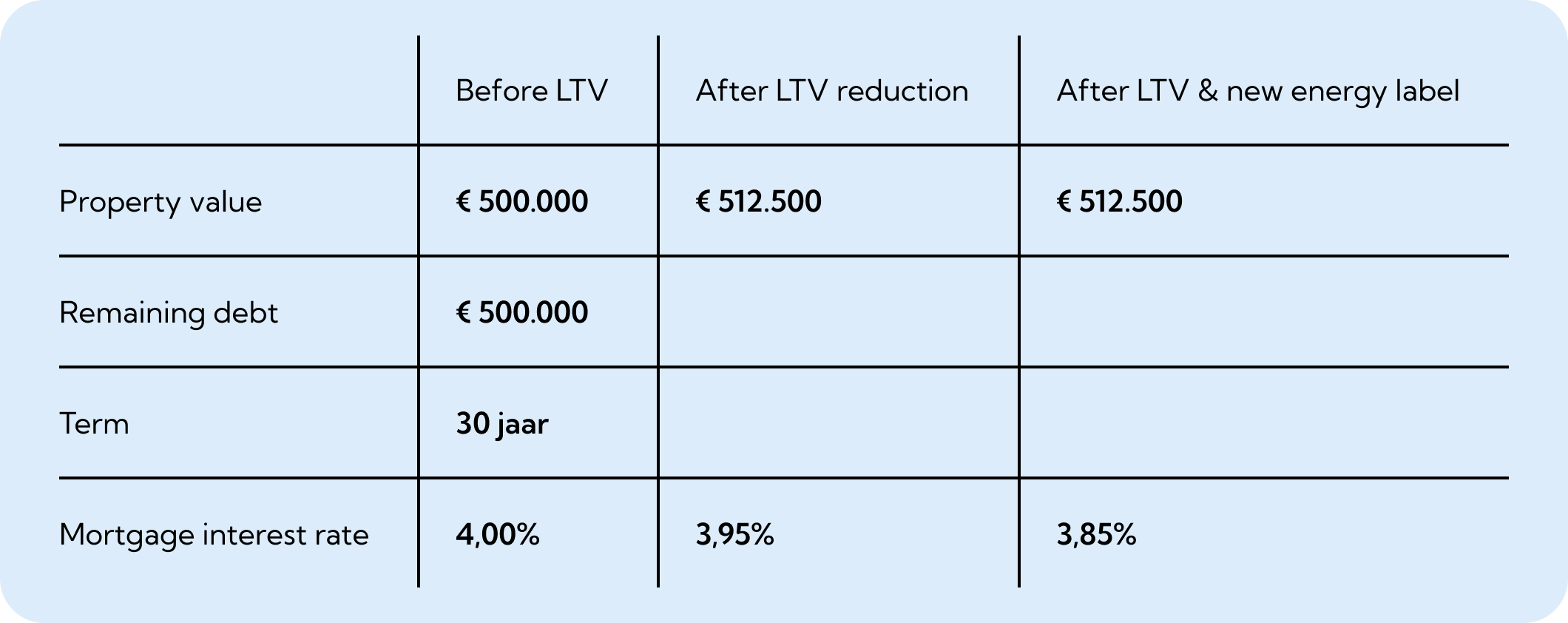
Due to the increase in the home’s value, the interest rate first drops by 0,05%. On top of that, there is an additional 0,10% discount due to the improvement in the energy rating. In total, the interest rate therefore drops from 4,00% to 3,85%.
And how does this affect your wallet?
If you add up the lower energy costs and the loan from the National Heat Fund, you arrive at this net monthly amount:
- Energy savings: + €47.00
- Mortgage benefit from LTV reduction: + €10.66
- Mortgage benefit from better energy rating: + €21.18
- National Heat Fund loan costs (after tax deduction): - €32.41
- Total net monthly gain: + €46.43
- Energy savings: + €47.00
In short: you’ll be better off by about €46 every month, without putting up any of your own money.*
The math often adds up. We just don’t always see it yet. Sustainability isn’t just about costs or technology. It’s about the big picture: lower energy bills, increased home value, and sometimes even a lower mortgage rate.
Then the question changes. No longer: Can I afford this? But: Why wouldn’t I do it? Prets makes it clear. Then the choice follows naturally.
The heat pump is simple. The forms are not.
The math adds up. Yet people still regularly back out. Not because of the heat pump. But because of the paperwork.
Arranging a loan involves paperwork. For many households, that quickly feels complicated. Installers often want to help, but they’re not allowed to do so under the rules of the Netherlands Authority for the Financial Markets (AFM). And so, a good plan sometimes falls through after all.
Prets believes that making homes more sustainable should be achievable for every household. Not just in theory, but in practice as well. Through Prets, homeowners receive accessible assistance with their application. This way, we remove a major hurdle. Not the technology. Not the will. But the final step. So that making homes more sustainable becomes clear, achievable, and stress-free for more households.
Source: https://publications.tno.nl/publication/34644335/JV7J26Wj/CPB-TNO-2025-inkomenseffecten.pdf
*Note: This calculation example is based on assumptions and averages. The exact terms and conditions for LTV and energy efficiency label discounts vary by lender. This example is intended solely to illustrate that investing in making a home more sustainable involves many more financial considerations than just lower energy bills.
Ready to go green?
Check your eligibility and start financing your sustainable upgrade today.